Twice a year the TU Delft organises the Exchange Week focused on educational innovation. On November 29th, 30th, and December 1st, 2023, we are hosting the fall edition of the TU Delft Exchange Week for Higher Education Institutions. During this three-day event we will focus on exploring innovations in education to promote continuous learning.
Enhancing Continuous Learning, Continuous professional development, Lifelong Learning. How do we at universities enable and facilitate the continuous development process of professionals in the worlds of teaching and beyond? What challenges do we see? And how do we overcome those challenges? This main topic is central to the upcoming TU Delft Exchange week.
This week is a collaboration of the TU Delft Teaching Academy, Teaching & Learning Services and the Extension School. We look forward to exchanging experiences on education innovation and Continuous learning for both teaching staff and professionals in various fields. Interaction, networking, exchange of experiences and diving into specific challenges and topics are key.
Open Education Day
I'm also organising an Open Education Day on Tuesday 28th of November 2023. If Open Education is a relevant topic to you and your institution, we encourage you combine this event with the TU Delft Exchange Week. The Open Education Day is a collaboration of the Extension School and the TU Delft Library.
Vorige week werd bekend dat het kabinet heeft besloten om te stoppen met STAP. Dit is een onverstandig besluit en niet goed voor levenslang ontwikkelen in Nederland.
Stimulering Arbeidsmarkt
STAP staat voor de regeling STimulering Arbeidsmarkt Positie en biedt werkende en werkzoekende van Nederland de mogelijk om jaarlijks 1000 euro subsidie te krijgen voor een bij- of omscholingscursus. Deze regeling was de opvolger van de belastingaftrek die we hiervoor hadden. Het doel van STAP was om het laagdrempeliger te maken voor alle inwoners om hier gebruik van te maken.
Zoals altijd met nieuwe regelingen is deze in het begin niet perfect en kwam STAP vooral in het nieuws door misbruik dat ervan werd gemaakt. De afgelopen maanden is er hard gewerkt om deze misstanden aan te pakken en de regeling elke ronde weer te verbeteren.
Veel interesse
Je kan ook zeggen dat de regeling zeer succesvol was. Op 1 mei was binnen 3 uur het budget van 34 miljoen alweer verdeeld over 38.000 aanvragers. Dit betekent ook dat er meer dan 120.000 aanvragers teleurgesteld zijn. Dit voelt voor een deelnemer als een loterij.
Uit de gegevens van het UWV blijkt dat een groot deel van het budget terecht komt bij MBO-ers en ZZP-ers. Dus de doelstelling om laagdrempeliger te zijn, lijkt gelukt.
TU Delft Extension School
De TU Delft Extension School heeft ook aanbod dat in aanmerking komt voor de STAP-subsidie. Vanuit opleidersperspectief was de regeling erg bureaucratisch en zorgde voor veel administratief werk. De Extension School heeft in 2022 meegedaan aan 4 rondes met 13 cursussen. Hiervoor kregen we 138 inschrijvingen, waarvan er uiteindelijk maar 15 deelnemers de subsidie daadwerkelijk gekregen hebben. Alles bij elkaar maakt dat voor ons de regeling eigenlijk verliesgevend was.
Levenslang ontwikkelen
De reden om er toch aan deel te nemen was dat wij levenslang ontwikkelen (LLO) essentieel vinden voor de talentontwikkeling van de beroepsbevoling. Met alle uitdagingen die ons te wachten staan hebben wij iedereen hard nodig. Daar hebben universiteiten ook een duidelijke rol in, zoals ook duidelijk vermeld in de UNL position paper.
Het regeerakkoord zet vol in op bij- en omscholing voor de professionele ontwikkeling van de beroepsbevolking. Het is teleurstellend dat de STAP-regeling nu niet de kans krijgt om zich verder uit te ontwikkelen. Dit is een stap terug voor LLO in Nederland!
Ik roep het kabinet op nog eens goed na te denken of het nu wel verstandig is om volledig te stoppen met STAP. Je gooit hier alle investeringen die door de UWV en alle opleiders zijn gedaan in een keer mee weg. Het ontwikkelen van een alternatief kost tijd en ook weer veel geld.
Before Covid we organised an Erasmus Exchange Week for anyone interested in the teaching and learning activities of the TU Delft, including the Extension School, New Media Centre, Blended learning. Last year we started this again with Erasmus Exchange Days and this year the "normal" programme returns. From April 12 to 14 we are organising the Erasmus Exchange Week again in the TU Delft Teaching Lab.
During this Exchange Week we will cover, amongst others, the topics:
Online education for lifelong learners, how to support and organise
a vibrant community of lecturers contributing to innovating Delft Engineering Education
How to successfully organise a teaching support center
Cookbook Education Spaces: requirements for standarized fuctionalities and operations
innovation through multimedia.
Interested in joining us that week, don't wait to register! There are only limited places available.
For European participants, you can use an Erasmus+ staff mobility grant to finance the trip.
Since a couple years the TU Delft Extension School is offering two courses on designing and teaching an online course. We have developed these courses for our own teachers to get them up prepared for offering a course via the Extension School and since 2019 we also offer these courses to anyone interested. During the pandemic, we have run these courses bi-monthly to help teacher deal with remote online teaching.
Now it was time for a revamp based on the feedback we received and the increasing need we see for educators and trainers to gain specific skills to teach online in blended or hybrid modes, both on campus and for professional education. The advantage of a new training by my colleagues at the TU Delft Extension School is that it combines hands on experimentation with personal feedback on digital course design. It focuses on innovative teaching and design methods with a learner-centred approach to help teachers achieve various goals – including converting an existing face-to-face course, moving towards blended learning, and developing stronger skills as an instructional designer.
At the end of the course, participants walk away with a practical blueprint, a storyboard, the setup of a first module on a learning platform of their choice, and a communication plan.
The 4-week long training is structured around key course development phases: plan, produce, run, and evaluate. Bi-weekly webinars are two-fold opportunities for attendees: they receive feedback and actively connect with peers while experiencing first-hand tools and techniques for learner engagement. Demos and try-out moments are included to show what options are available and to experiment with those.
Due to its flexible, online format, the course can be started at any time that suits the learners between 28 March and 30 May. For more information – visit the course page.
Before Covid we regularly organised an Erasmus Exchange week, last one in January 2020, to share our expertise and practice on online, blended and campus education. During Covid we were too busy with all the emergency remote teaching, but this fall we have decided to pick it up. We have noticed in the last couple of months that the requests to visit our campus and hear more about our operations are picking up, so there is an interest. We did change the format because we are also organising an multiplier event for the Erasmus+ project Digitel Pro.
TU Delft Exchange Day
On 5 October 2022 a TU Delft Exchange Day on Education will be hosted at the TU Delft Teaching Lab for (international) higher education institutions. Are you from an higher education institution and interested to learn more about education innovation and development at TU Delft? Please let us know through the registration form by clicking the button below.
Indication of the Programme Components
Welcome & Opening by Rob Mudde, Vice Rector Magnificus/Vice President Education
Teaching Academy and Teaching Lab by Annoesjka Cabo, Academic Director Teaching Academy
"Engineer of the Future" by Hans Hellendoorn, Pro Vice Rector Magnificus Joint Education Affairs
"Innovation in Engineering Education" by Remon Rooij, Delft co-leader 4TU Centre for Engineering Education
Teaching & Learning Services by Franca Jonquiere, Manager Teaching & Learning Services
Extension School by Arno Smets, Director of ES Education TU Delft Extension School
NewMedia Centre: Media Production & Media Facilities for Education by Michel Beerens, Head NewMedia Centre
The DigiTeL Pro partnership brings together advanced "Schools" in research, innovation, and good practices in synchronous hybrid (KU Leuven), blended (TU Delft), and online and distance learning (Universitat Oberta de Catalunya (UOC), Open Universiteit (OUNL) and UNINETTUNO).
The event on October 6th 12:00 - 17:00 offers you an excellent opportunity for an update of last developments, primarily for course and curriculum developers and for all those who support teaching staff and learners, and secondly for leaders who direct these processes in higher education. Relevant post-COVID issues are addressed, e.g. active learning, interaction and collaborative learning, inclusiveness, and assessment and feedback.
The event will cover:
Outcomes/findings on the three formats of education Synchronous Hybrid, Online, and Blended Education, shared by experts of the DigiTeL Pro partnership;
Insights into how these theoretical formats support course design in your institution;
Opportunities to discuss how to apply models and guidelines in practice
Please find more information on the event, such as the agenda and the registration form, on our Eventbrite page.
Location
Both events will be in the TU Teaching Lab. The Teaching Lab is the physical home of the Teaching Academy (the network for and by lecturers at the TU Delft). It is a dedicated space with special rooms for all TU Delft lecturers to connect, to share developments and innovation in education, to experiment with educational practices, and to spotlight lecturers.
Earlier this year the Dutch government changed the way professional learners can get funding for their professional development. It used to go via a tax reduction. Since this year life long learners can apply to receive 1000 euro subsidy for their training.
Off course they made the process quiet cumbersome and the yearly budget is limited. The budget is released per time period. The next batch will open on July 1st and it is expected that the budget will be used within a day.
TU Delft online courses
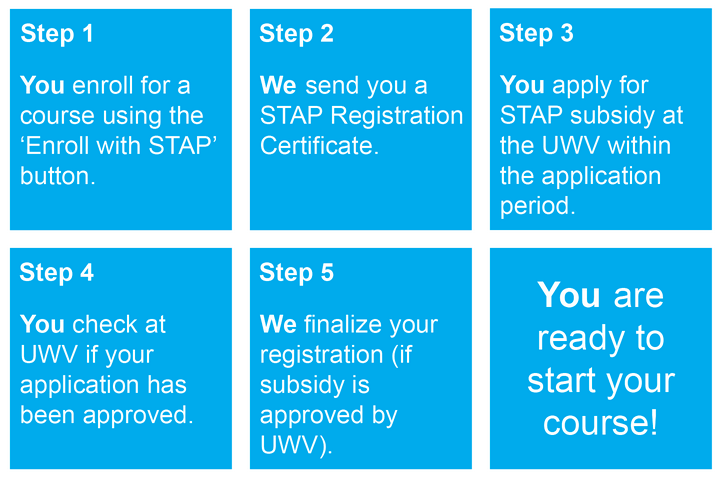
Since last week we have deployed the integration on the website of TU Delft Extension School to apply for this subsidy. Below you see the different steps:
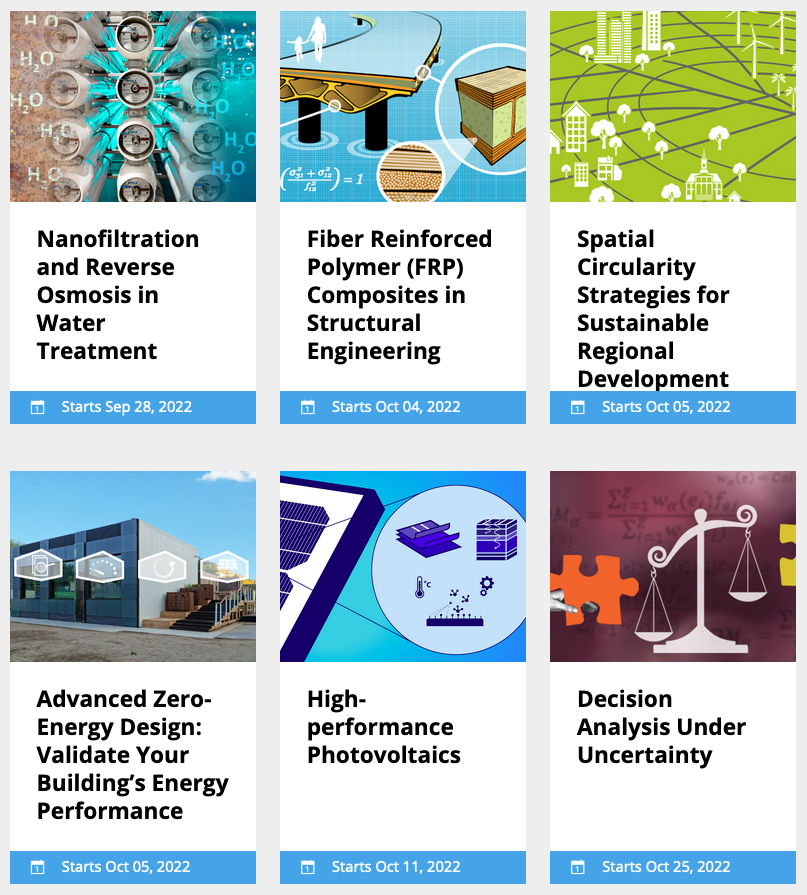
Currently we have six courses that you can enroll in and apply for the STAP budget:
The TU Delft (Extension School and Teaching & Learning Services) is one of the leading partners in the Digitel Pro partnership. The DigiTel Pro partnership brings together advanced “schools” in research, innovation, and good practice in synchronous hybrid (KU Leuven), blended learning (TU Delft), and online and distance learning (Universitat Oberta de Catalunya, The Open Universiteit (OUNL), UNINETTUNO). It will also focus on the student readiness for online learning (DCU-NIDL, Dublin).
Ten years ago Open Education Global started withe the Open Education Awards. To celebrate this, David Kindler, Marcela Morales & Paul Stacey have written an interesting book to provide an overview of 10 years of Open Education Awards.
"Starting in 2011, as part of its stewarding role, Open Education Global has provided annual recognition to outstanding contributions in the global open education community, recognizing exemplary leaders, distinctive Open Educational Resources, and open projects and initiatives. As part of the 10th anniversary of these awards, OEGlobal is publishing this Education For All book collecting all ten years of award winners into a single volume. This book is a celebration of their achievements. We plan to update this book each year as a living document."
Awards for TU Delft
In these 10 years the TU Delft has received many awards for our open education activities:
Leadership Award for Anka Mulder (2014)
Educator Award for Felienne Hermans (2018)
Student Award for Dirk Ulijn and Bart Meeuwissen (2019)
Open Website Award for TU Delft OCW website (2014)
Outstanding Course Awards for Sanitary Engineering (2012), Introduction to Aerospace Engineering I (2013), Delft Design Guide (2013), and The Human Controller (2015)
Open MOOC Awards for Solar Energy (2014), Introduction to Water Treatment (2014), Delft Design Approach (2015), Solving Complex Problems (2015), Pre-University Calculus (2016)
Open Curation / Repository Award for Grasple (2019)
Open Policy Award for our Strategic Framework "Impact for a Better Society" (2018)
The initiative of the Open Education Awards are a great way to recognise the open education activities around the world and helps individuals in advancing their career.
The DigiTel Pro partnership brings together advanced “schools” in research, innovation and good practice in synchronous hybrid (KU Leuven), blended learning (TU Delft) and online and distance learning (Universitat Oberta de Catalunya, The Open University of The Netherlands, UNINETTUNO). It will also focus on the student readiness for online learning (DCU-NIDL, Dublin).
Experts develop online courses on models and guidelines for the design, development and delivery for each of these three predominant formats in a post-Corona perspective. The courses will be in line with the most recent research and innovation.
The courses will be launched on Thursday 18th of November 2021, 14.00-16.00 CET.
Please join the Launch of our Course Programme on:
Synchronous Hybrid Education: based on settings that have in common that both on-site or 'here' students and remote or 'there' students are included simultaneously;
Blending your Education: with a deliberate mix of synchronous and asynchronous methods: based on a course design with a conscious combination of online and offline learning activities;
Online Distance Education: based on a course design with a continuous physical separation between teacher and student.
Student Readiness for Digital Education: giving students the digital edge to succeed as an online learner at university and setting them on the path to achieving their learning goals.
During this launch you will be able to meet the team leaders in dedicated break-out sessions.
Participation in the course programme, starting early 2022, will enable you as educator to make the transition from emergency online teaching during Covid-19 to fully professional teaching and learning in digital higher education. This first mutual acquaintance will ensure that the courses connect with your real needs and expectations. At the end of the session you will be able to continue interaction with the team leaders up till the start of the course.
Please find more information on the launch and the registration on our Eventbrite page.
This week I chaired my last board meeting of Open Education Global as president of the Board. Last year already my term as elected board member ended and this week also term as president ended.
I'm proud to see in what an excellent shape Open Education Global is in. In this blog I would like address a couple of reasons why I say that.
New strategy
Recently we published our the new strategy of OE Global: Open for Public Good. In this strategy we position OE Global as an open education steward within the education ecosystem. OEGlobal’s primary role is as a connector. We foster knowledge exchange, advance sus- tainable systemic change and open policies, amplify impact, and connect local open edu- cation efforts to global ones.
Our goals for open education are:
Open Education is Socially Just
Open Education is a public good
Open Education is inclusive
Open Education is Accessible, Affordable, and Adaptable
Open Education is Collaborative, facilitated by community and stewards
Open Education is impactful.
OEGlobal sees these goals for open education coming together dynamically with the learner at the centre and the whole greater than the sum of the parts.
Last year the Hewlett Foundation renewed our core operating grant for 2021-2023. We also secured other grants. Not only did our yearly budget almost double in the last 3 years, it is also secured for a couple of years. This brings OE Global in a financial stable period and means we can focus on executing our strategy.
Great staff
Earlier this year 3 employees decided (for various reasons) to leave the organisation. We managed to hire some great new staff members. Together with our Executive Director Paul Stacey I'm convinced that they will be able to further develop the organisation and execute our new strategy together with our board and our members.
President Patterson
It is always great to step down if you know that your successor will do an excellent job. In my last board meeting, the board elected Lena Patterson as president of the board. Lena has been a part of the eCampusOntario team since the organization opened shop in August 2015. She worked closely with the government to establish the consortium model in Ontario and now heads up a growing project team in her role as Senior Director, Programs and Stakeholder Relations. Lena focuses on cross-pollination, collaboration and the promotion of open education, access and innovation in online and technology-enabled teaching and learning across the province.
I have full confident that Lena will take OE Global to the next phase with the new strategic plan. I'm also happy that our two appointed board members, Catthy Casserly and Martin Dougiamas, will continue to serve on the board.
Concluding remarks
It is great time for Open Education Global and it even has a brighter future. I hope to see everone at the OE Global Conference online and hopefully in Nantes.
I continue to participate in the board as past-president. That is an non-voting position.